The Unfolding Universes of Winston Hacking [excerpt]
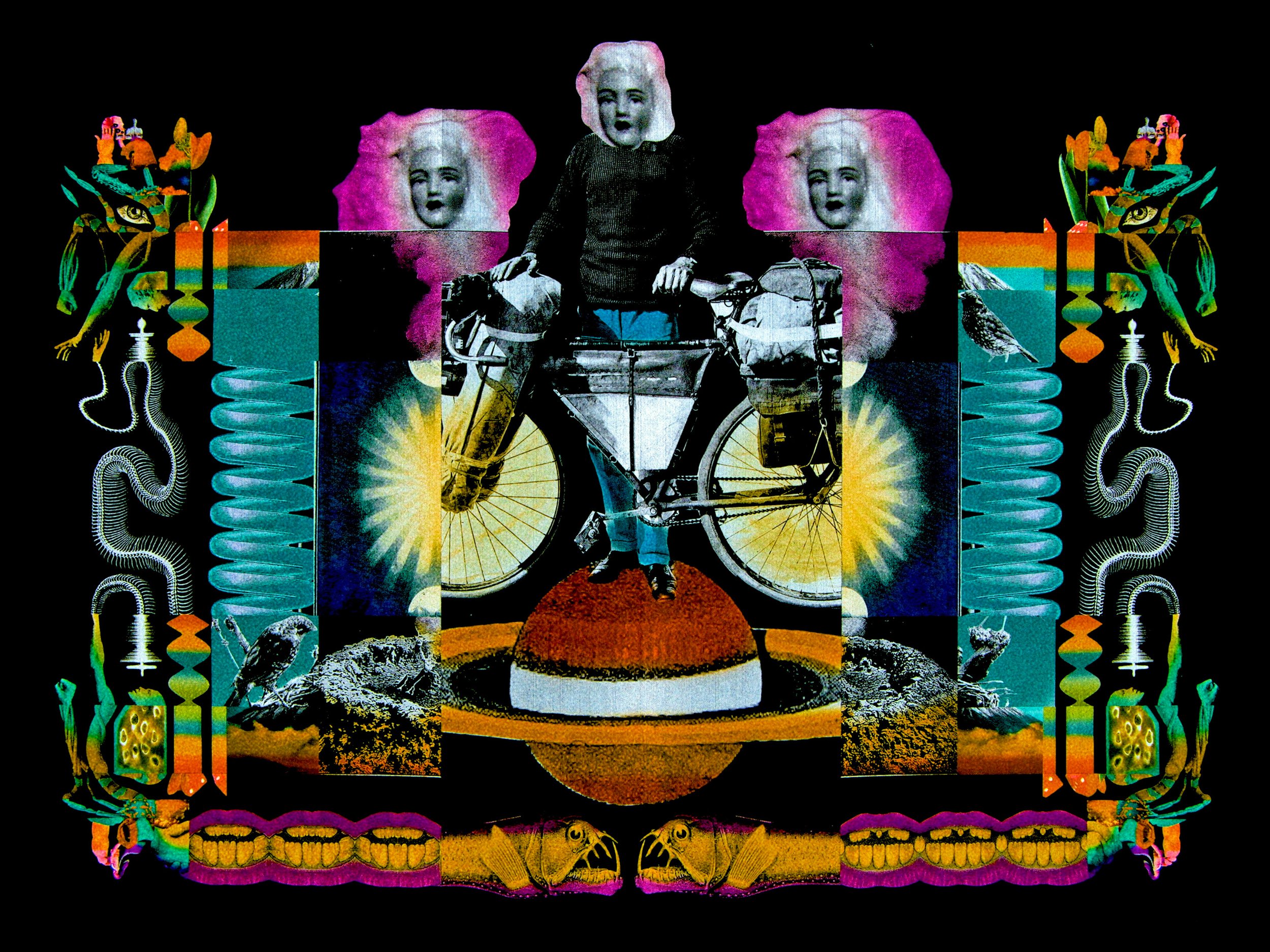
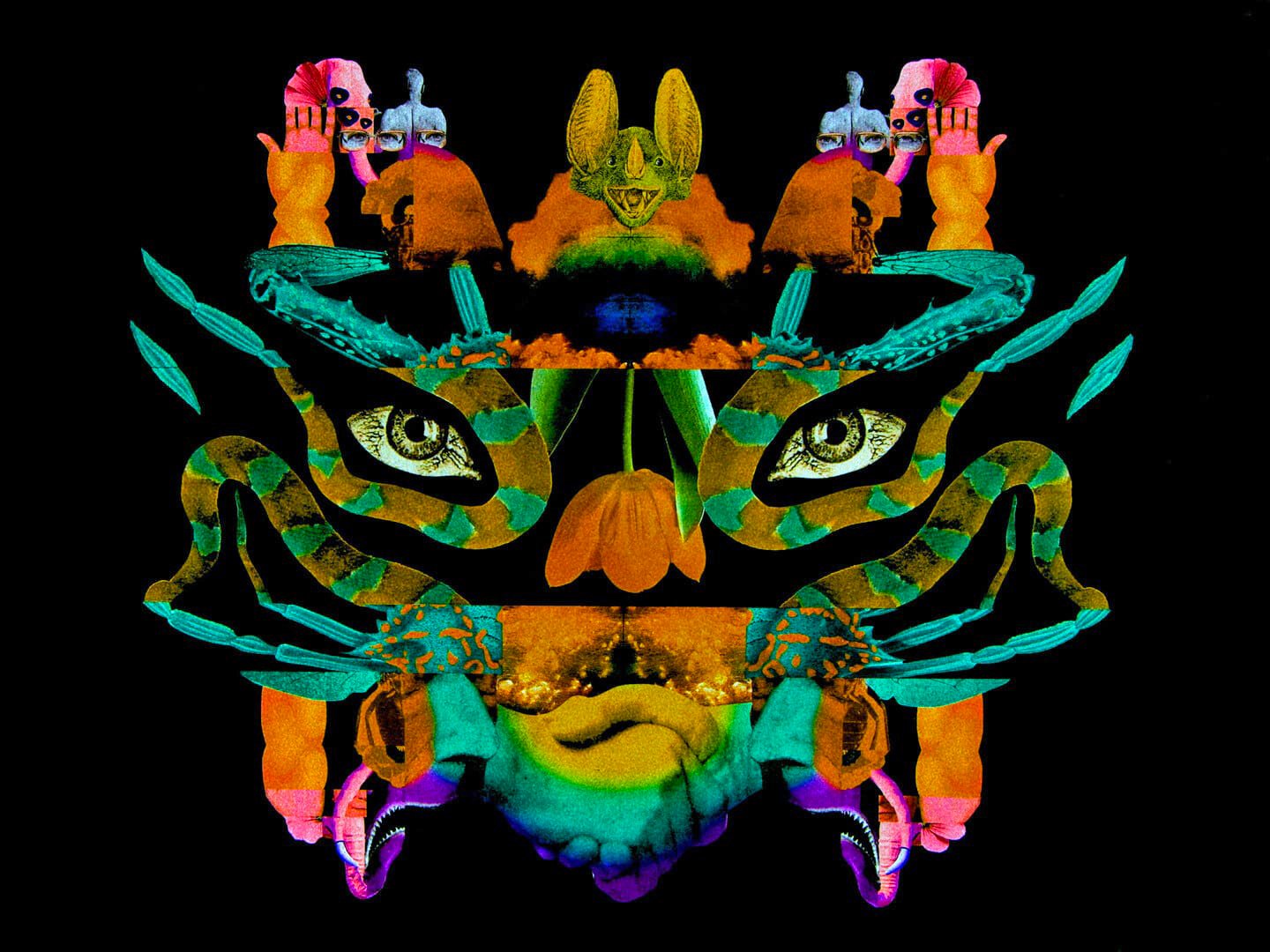
Duotone Handshake is a film that unfolds before your eyes. Starting with a single image of a flower, the film expands outwards and upwards through a series of expansions along central horizontal and vertical axes. In a witty reversal of Mad magazine’s fold-in back covers, Hacking’s film folds-out to create an ever-expanding visual universe. Just as the Eames’ Powers of Ten (1977) attempts to traverse the physical universe using a zoom and a series of exponential expansions and contractions, Hacking takes us through a world of images using the fold. Each image, and collaged tableau, unfolds to reveal a further secret level hidden below what initially appears to be a flat, unbroken surface. As a result, the film feels like it is making a series of occult correspondences and connections, getting deeper and deeper into things to convey a secret history of the world as it has been captured in images, gleaned from magazines and textbooks, instructional films and psychedelic illustrations. But, in the end, the whole world of images, and whatever accounts, narratives or conspiracies you can spin from them, ultimately rest on a void. A hole opens up in the middle of the page and eventually swallows the universe in its entirety. Just as the Eames’ film reached the edges of the known universe, both macro and micro, Hacking’s folds reach the base of all knowledge—form is emptiness and emptiness is form.
The images used in Duotone Handshake are relatively ordinary, yet they gradually acquire an esoteric, even psychedelic, quality. This transformation is produced partly through Hacking’s distinctive colour palette and partly through the film’s psychotronic sound design—sound and mastering by Zukerman and Sandro Perri respectively—which makes familiar objects appear strange, unstable and charged with hidden significance. The effect seems deliberate, particularly given Hacking’s recurring use of mushrooms and other imagery associated with altered states of consciousness. In visual terms, the film evokes the collage work of Eduardo Paolozzi, particularly the dense combinations of mass-media imagery and geometrics that characterize his late 1960s prints and collages. But there is something in Duotone as well of the graphic work of Tadanori Yokoo, whose close collaboration with avant-garde composer Toshi Ichiyanagi offer a tantalizing analogue for the Hacking-Zukerman partnership.
As much as the conceptual and technical complexities of Hacking’s films suggest that they need to be fully thought out in advance and meticulously planned, he claimed in a recent interview that “my practice is about being surprised the whole way through.” There is no contradiction here. The lesson from Hacking is that no matter how comprehensively you attempt to control and command the material at hand and the processes that put it all in motion, it is all for naught if you foreclose on the possibility of the unexpected.
— Clint Enns and Andrew Burke (an extended version of this article will appear in a forthcoming issue of 24 images)